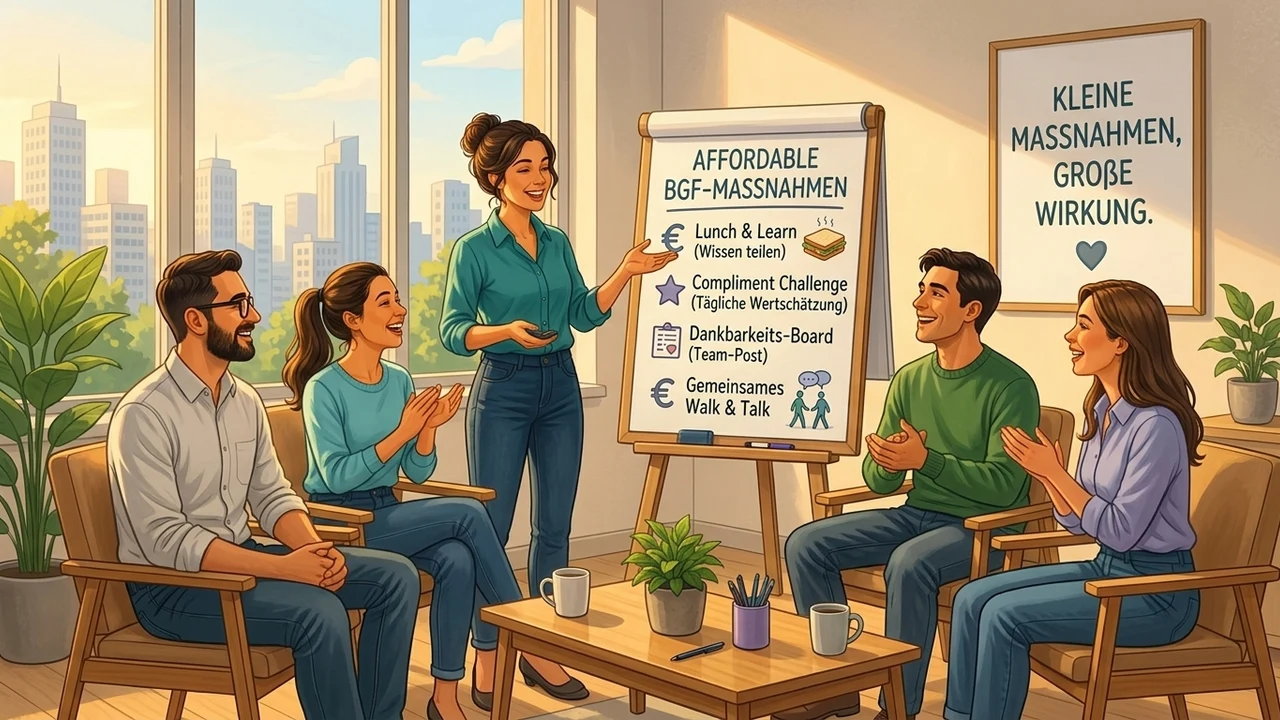
Affordable WHP for SMBs
What can I do to make my employees healthier without a big budget?
Note: this guide refers to German law. Start with no budget: movement breaks, drinking water and an internal health team cost little or nothing. On top of that come three levers you need to keep apart: statutory health insurers subsidize certified prevention courses for their insured members (Section 20 SGB V) and fund workplace health promotion projects (Section 20b SGB V) — with no entitlement; the insurer decides project by project. And the employer can provide health benefits of up to €600 per employee per year tax-free (Section 3 No. 34 EStG): for certified courses or for measures within the workplace health promotion process.
WHP Measures for SMBs by Effort and Cost
| Measure | Out-of-Pocket Cost | Funding | Effort |
|---|---|---|---|
| Movement Breaks / Stretching Routines | €0 | — | 15-min. rollout |
| Providing Drinking Water | low | — | minimal |
| Back Health Course (ZPP-certified, e.g., Upfit) | depends on insurer and employer subsidy | Section 20 SGB V (insurer subsidizes its insured members) | Booked via platform |
| Nutrition Coaching (ZPP-certified) | depends on insurer and employer subsidy | Section 20 SGB V; employer subsidy tax-free under Section 3 No. 34 EStG | Booked via platform |
| WHP Process & Survey (EasyWHP) | from €0 (free plan) | Route to tax-free measures without certification (Section 3 No. 34 EStG) | a few hours of setup, then 1–2 hours per week |
Which WHP measures cost almost nothing?
Even without a health budget, there are effective measures: short movement breaks at the screen (the German workplace regulation ASR A6 of 2024 recommends interrupting screen work, as a guide around five minutes per hour), drinking water, a fruit basket and correct ergonomic seating. They help prevent complaints and support concentration — at virtually no cost.
An internal health team (1–2 volunteer employees acting as health champions) coordinates these measures and costs only time, not money.
- Movement breaks and active break routines (free)
- Providing water and healthy snacks (low running costs)
- Ergonomic workplace check (one-time, often free via your health insurer)
- Appoint health champions from within the team
- Assess your WHP maturity level (about 7 min., free on WHPCompass)
What do health insurers fund: courses (Section 20) or workplace projects (Section 20b)?
Statutory health insurers support prevention in two ways that must not be confused. Under Section 20 SGB V, they subsidize certified prevention courses (ZPP), such as back or nutrition courses from providers like Upfit — for their own insured members and in an amount each insurer sets itself. What employees or the company end up paying depends on the insurer, the course and any employer subsidy.
Under Section 20b SGB V, health insurers fund health promotion in the workplace itself — as a project, such as a health day or an annual budget. No certification is provided for this, and the company has no entitlement: the insurer decides project by project, often based on how many of the company's employees it insures. Guidance comes from the action areas of the GKV Prevention Guide (physical activity, nutrition, stress management, addiction prevention). If you have documented needs, goals and measures, you go into the conversation with the insurer with data rather than a request — EasyWHP structures this process and documents it transparently.
Which employer health benefits are tax-free?
Employers can spend up to €600 per employee per year on health measures free of tax and social security contributions — on top of the wages already owed, not through salary conversion. There are two routes: certified prevention courses under Section 20 SGB V (route 1) or measures implemented within the workplace health promotion process — with a needs analysis and employee involvement (route 2). No certification is provided for route 2.
Not eligible are, among other things, sports club and gym memberships, corporate fitness contracts, massages and screenings. The €600 is a tax-free allowance and a ceiling, not a subsidy and not a target: with 20 employees, up to €12,000 a year could be tax-free; in practice, a fraction is often enough. EasyWHP provides the documented process for route 2 — so your measures do not have to be certified. In the end, only your tax advisor can confirm this.
Where should small companies start?
This order is a good fit for small companies:
- 1. Assess your WHP maturity level (free, about 7 min.) → shows the biggest levers
- 2. Offer a certified prevention course that health insurers subsidize for their insured members (Upfit, a back health course, etc.)
- 3. Provide health benefits tax-free through payroll, on top of wages (allowance under Section 3 No. 34 EStG — coordinate with your tax advisor)
- 4. Gradually expand to further action areas (stress management, nutrition)
Related measures & topics
Key takeaways
- Note: This guide reflects German law (SGB V, EStG) for companies based in Germany. WHP for SMBs starts free: movement breaks, drinking water, health champions.
- Health insurers subsidize certified courses (Section 20 SGB V) and fund workplace projects (Section 20b SGB V) — there is no commitment.
- Tax-free allowance of up to €600 per employee per year (Section 3 No. 34 EStG): for certified courses or measures within the workplace health promotion process — your tax advisor can confirm this.
- EasyWHP provides this process with manageable effort (1–2 hrs/week).
Frequently asked questions
What does WHP actually cost for a small company with 10–20 employees?+
Getting started is almost free: movement breaks and health champions cost only time. Health insurers subsidise certified courses (back health, nutrition) for their insured members under Section 20 SGB V — each insurer sets the amount itself. In addition, health services provided by the employer remain tax-free up to €600 per employee per year (Section 3 No. 34 EStG, German law) — an allowance, not a subsidy: with 15 employees, that is at most €9,000 a year. That is the tax-free ceiling, not a target; only your tax adviser can confirm the tax exemption.
As a small company, do I need to introduce a WHP program, or is a single measure enough?+
Single measures are possible. Under Section 3 No. 34 EStG, however, they are then tax-free only as a certified course. Measures without certification can be tax-free if they are implemented within the workplace health promotion process — with a needs analysis and employee involvement. A documented process also helps in conversations with the health insurer. EasyWHP guides you through this process, with 1–2 hours per week.
Which measures does the health insurer cover?+
There are two routes. Under Section 20 SGB V, insurers subsidize certified prevention courses for their insured members — e.g., back health, nutrition or stress management; Upfit offers such ZPP-certified courses. Under Section 20b SGB V, insurers fund workplace health promotion projects. There is no certification and no entitlement for this — the insurer decides project by project.
How much time do I need to invest as a business owner to organize this?+
A few hours of setup to get started, then 1–2 hours per week. EasyWHP supports needs assessment, action planning and reporting — even without your own HR department.
Can the employer pay for a gym membership tax-free?+
Not under the tax allowance of § 3 Nr. 34 EStG: gym and sports club fees and corporate fitness contracts are not eligible there. A benefit in kind under § 8(2) sentence 11 EStG is possible — tax-free up to €50 per month, as a separate exemption limit alongside the allowance. German statutory health insurers do not fund gym fees under § 20b SGB V. Your tax adviser confirms whether it fits in the individual case (German law).
Start WHP — Without a Big Budget
EasyWHP guides you through the workplace health promotion process — so measures can be tax-free even without certification. The maturity check shows you where you can start for free today.
Sources
- Section 20 SGB V (gesetze-im-internet.de) ↗
- Section 20b SGB V (gesetze-im-internet.de) ↗
- Section 3 No. 34 EStG (gesetze-im-internet.de) ↗
- GKV Prevention Guide (GKV-Spitzenverband) ↗
Last updated: 2026-10-15. Not legal or tax advice — have your specific case reviewed by a professional.