← Best practice library
Prevention & Early Detectionwith budgetmulti-day
The Health Day That Actually Works
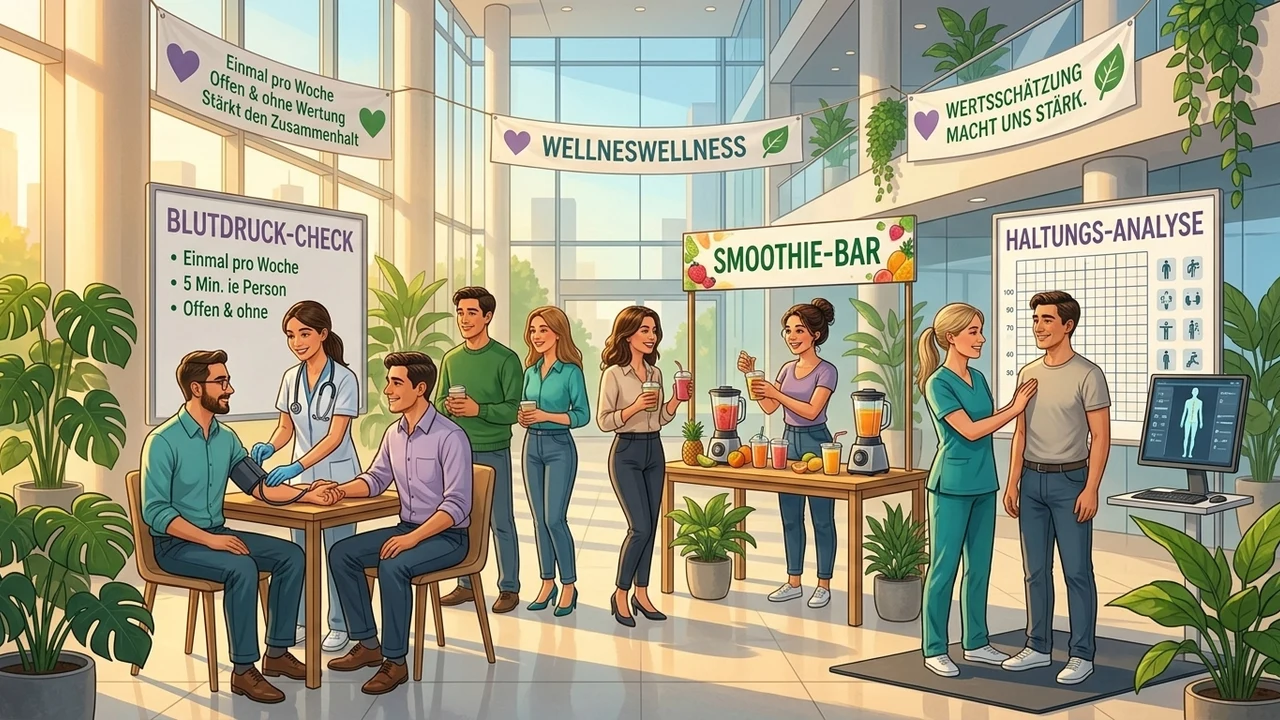
The most visible BGM event of the year – dosed correctly: a focused health day with preventive care offerings has a stronger impact than an overloaded program.
Why the overloaded program gets in its own way A jam-packed day with twelve stations looks impressive on the poster and is overwhelming in reality. Attention fades after just a few hours, and every station either forms a queue or sits empty. Less is measurably more here: three to four really good offerings that people can experience without rushing are what stick.
What actually works on a health day Proven formats are concrete and personally experienceable – a measurement with an immediate result, a brief check by professionals, a low-threshold hands-on offer, an open conversation. What matters is that people go home with something tangible: an insight, a value, a first step.
The right setting amplifies the impact Around World Health Day in April, attention – both internal and external – is at its highest. And for smaller companies, this holds true: a self-organized mini health day with two good offerings is a fully valid entry point. The occasion makes the topic unmissable once a year; the measures behind it carry it through the rest of the year.
How to put it in place
- 1Datum, Ort und Budget festlegen und intern freigeben lassen
- 2Externe Anbieter buchen: Screenings (Blutdruck, Sehtest), Bewegungs-Stationen, Ernährungs- und Ergonomie-Beratung, Entspannungs-Angebote
- 3Programm takten: Stationen-Plan mit Zeitfenstern, damit es an keinem Stand staut
- 4Verantwortlichkeiten klären: Ansprechperson pro Station, Auf- und Abbau, Catering
- 5Programm attraktiv ankündigen: Was gibt es, warum lohnt es sich?
- 6Teilnahme während der Arbeitszeit ermöglichen – das ist der größte Hebel für die Quote
- 7Optional Anmeldung für beliebte Stationen (z.B. Screenings) mit Zeitfenstern
- 8Guten Empfang und klare Orientierung sicherstellen (Lageplan, Begrüßung, Ansprechpartner)
- 9Stationen betreuen und auf gleichmäßige Auslastung achten
- 10Datenschutz an medizinischen Stationen wahren: Ergebnisse bleiben bei den Teilnehmenden
- 11Atmosphäre positiv halten – der Tag ist Wertschätzung, kein Pflichttermin
- 12Teilnahme je Station auswerten (anonymisiert) fürs BGF-Reporting
- 13Feedback der Mitarbeitenden und Anbieter einholen
- 14Anschluss schaffen: die beliebtesten Themen in dauerhafte Maßnahmen überführen
What you need
- Effort
- multi-day
- Cost
- with budget
- Duration
- 1 Tag
- Setup
- 2400 min
- ✓ Highlight event
- ✓ High visibility
- ✓ Employer brand
Eligible for funding: up to €600 tax-free
As part of a structured workplace health process, this measure is tax-free under § 3 no. 34 of the German Income Tax Act (EStG) up to €600 per employee per year — BGF-Kompass supplies the process. Certified offers (e.g. from Upfit) are additionally subsidised by statutory health insurers under § 20b SGB V.
Health-insurer funding & tax: how to apply →Start this measure now
Register for free — and the measure is ready to go in your cockpit: invitation, feedback survey and appointment are already set up. First cycle, first numbers for the boss.
Start for free nowRather take a look first? To the live demo →
Contributes to
Increase participation rate in BGF measures
Measure the impact with
Gesundheits-Puls (Kurzbefragung)
Action field
Prevention & Early Detection →A fitting occasion
Related best practices
Not sure where to start? 5-minute self-check →