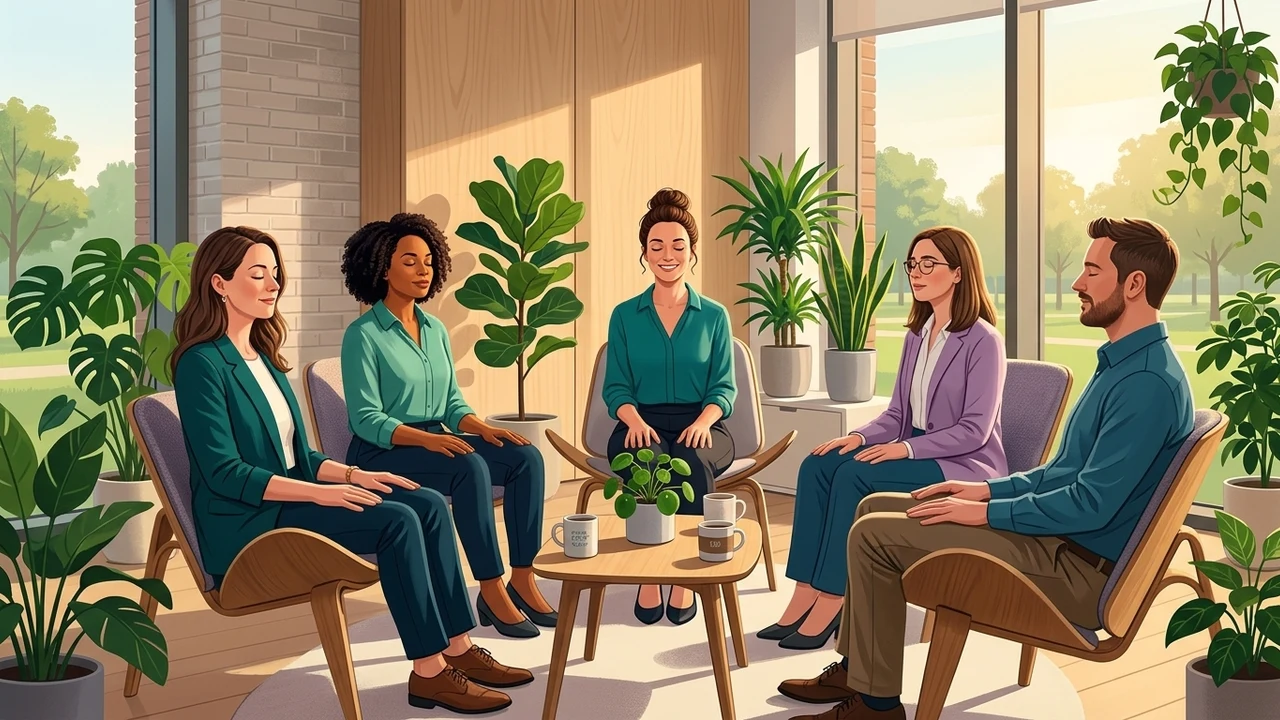
PMR course at work: progressive muscle relaxation according to Jacobson
Progressive muscle relaxation is a relaxation technique that can be learned in a few weeks: briefly tense muscle groups one after another, then let go. The exercises need no mat room and no sportswear; they are done sitting. That is why a PMR course fits well into the workplace, also for people who do not get much out of mindfulness or yoga.
How does a course work?
A course leader guides the group over several weeks, once a week. First, many muscle groups are practised individually, later shorter versions that also work during a break. At the end, participants receive instructions or recordings so they can continue alone.
How do you recognise a recognised course?
Ask whether the course is certified by the Central Prevention Testing Office (Zentrale Prüfstelle Prävention, ZPP) as a prevention course under § 20 SGB V (German law). The certificate applies to the course leader and the course. You will find course leaders in the marketplace or via your health insurance fund.
What does it cost?
The course leader invoices the course; you provide the room and the time. If the employer pays for a certified course in addition to wages, this can be tax-free (§ 3 Nr. 34 EStG, German law; allowance of up to €600 per person per year). Only your tax adviser can confirm this.
How do you put the measure in place?
- 1Find a course leader and ask for the certificate of the Central Prevention Testing Office (Zentrale Prüfstelle Prävention, ZPP)
- 2Set the dates, a quiet room and participation (working time or free time)
- 3Announce the course and collect registrations
- 4After the course, ask how well the exercises carry over into everyday life
Plan, invite, measure participation: EasyWHP, which offers WHPCompass free of charge, sets this measure up as a project, invites the workforce and shows how many people take part. How a measure runs in EasyWHP →
What do you need for it?
- Effort
- under 30 min
- Cost
- with budget
- Duration
- 8 weeks
- Setup
- 120 min
- ✓ Easy to learn, no previous knowledge needed
- ✓ Exercises done sitting, also during the working day
- ✓ Can be continued alone afterwards, for example with recordings
- ✓ With a certificate, a recognised prevention course under § 20 SGB V (German law)
Tax and health insurance: what is possible
Employer health benefits can be tax-free under § 3 no. 34 of the German Income Tax Act (EStG) up to €600 per employee per year — if they are provided in addition to the salary already owed and are either certified (§ 20 SGB V) or implemented within the company's health promotion process. Gym memberships and corporate fitness are not covered. For ZPP-certified courses (e.g. from Upfit), German statutory health insurers can reimburse all or part of the course fee to their insured members — then only the amount exceeding that reimbursement is tax-free. Projects within the company can be funded under § 20b SGB V, with no entitlement. Only your tax adviser can confirm the tax exemption.
Health insurance and tax: how to proceed →How it works in EasyWHP
This Best Practice in EasyWHP: adopt it, adapt it, measure the effect
Once adopted, the measure is ready in EasyWHP — with instructions, an invitation and surveys before and after. You adapt what fits your company and see at the end what it achieved.
Screenshots with demo data, no real people.
Adopt it for your company
Register for free — and the measure is ready to go in your cockpit: invitation, feedback survey and appointment are already set up. First cycle, first numbers for the boss.
Try EasyWHP for freeRather take a look first? To the live demo →
Contributes to
Measure the impact with
Action field
Stress & Mental Health →A fitting occasion
Related Best Practices
Not sure where to start? Self-check in approx. 7 minutes →