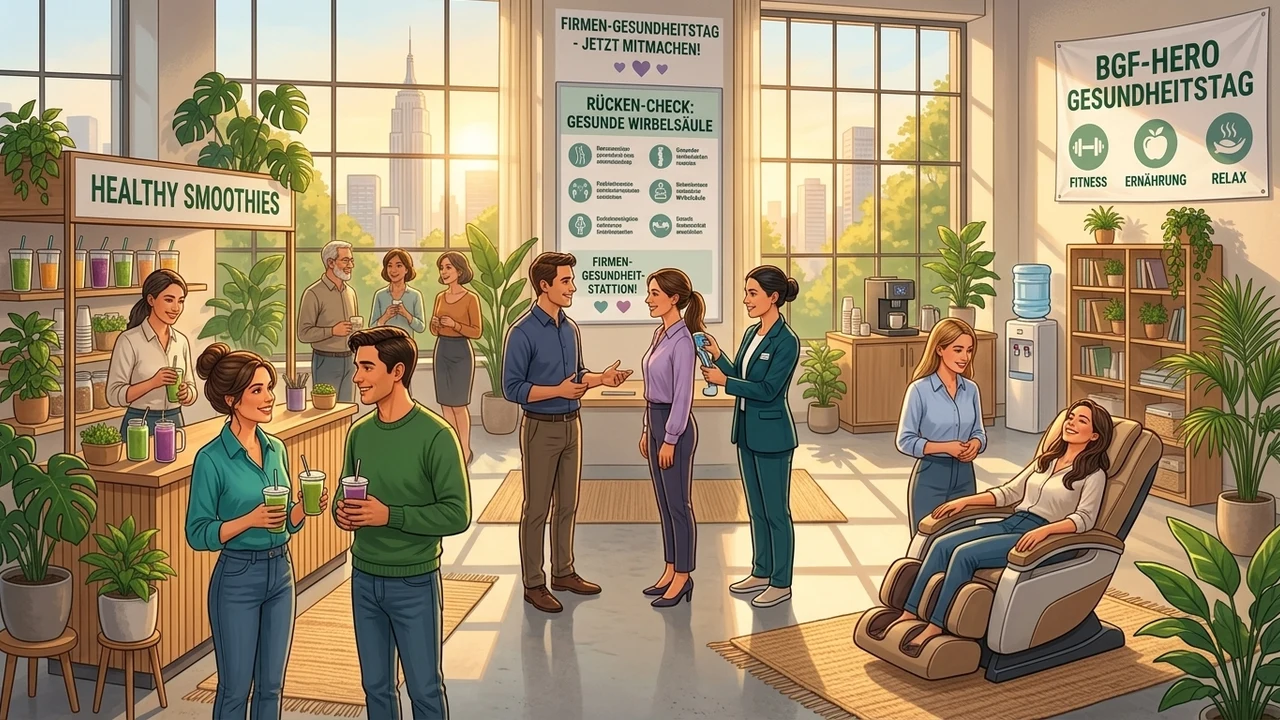
Setting aside a whole day for health once a year sounds like a lot – and is in fact one of the most impactful investments a company can make in its workforce. Not because of the individual activities on that day, but because of the signal it sends.
What an action day triggers that no newsletter can A health day creates experiences that employees talk about afterward. The blood pressure check that unexpectedly revealed high readings and made someone more attentive ever since. The back screening that showed the chair was set up wrong. The shoulder massage during lunch break. These moments aren't wellness cosmetics – they're genuine points of contact with one's own body, something that rarely happens in everyday work life.
What makes a health day successful The program needs a mix of active and informative, of mandatory and voluntary elements. Anyone forced to sit through lectures every three hours won't come back next year. Anyone who gets to try something themselves – an exercise, a check, a new offering – talks about it. The closing ritual, whether a shared lunch or a small prize for the most engaged team, determines whether the day is remembered as an event or as an obligation to get through.
How to put it in place
- 1Lege die 3 bis 4 Stationen fest: Rückencheck, Smoothie-Bar, Stresstest und Bewegungsparcours, und bestimme pro Station eine verantwortliche Person.
- 2Reserviere einen geeigneten Raum oder Außenbereich für den halben Tag und besorge das Material je Station (Matten, Mixer und Obst, Fragebögen, Parcours-Elemente).
- 3Erstelle einen groben Zeitplan mit Rotationsfenstern, damit sich die Teams gleichmäßig auf die Stationen verteilen.
- 4Verschicke die Einladung mit Datum, Uhrzeit, Ort und einer kurzen Beschreibung der vier Stationen.
- 5Öffne eine einfache Anmeldung oder Zeitfenster-Auswahl, damit du die Auslastung der Stationen abschätzen kannst.
- 6Bitte darum, bequeme Kleidung mitzubringen, und erinnere ein bis zwei Tage vorher an den Termin.
- 7Baue die Stationen rechtzeitig auf und weise die verantwortlichen Personen ein.
- 8Begrüße alle kurz, erkläre den Ablauf und die Rotation zwischen den Stationen.
- 9Behalte den Fluss im Blick, gleiche Warteschlangen aus und sorge für Nachschub an der Smoothie-Bar.
- 10Sammle per kurzer Umfrage Feedback, welche Station am besten ankam und was gefehlt hat.
- 11Halte fest, wie viele Personen teilgenommen haben und wie hoch der Aufwand je Station war.
- 12Leite aus dem Feedback ab, welche Stationen bei einer Wiederholung bleiben und welche du ersetzt.
What you need
- Effort
- half a day
- Cost
- under €100
- Duration
- 1 Tag
- Setup
- 480 min
- ✓ High visibility
- ✓ Experience character
- ✓ Great photo material
Eligible for funding: up to €600 tax-free
As part of a structured workplace health process, this measure is tax-free under § 3 no. 34 of the German Income Tax Act (EStG) up to €600 per employee per year — BGF-Kompass supplies the process. Certified offers (e.g. from Upfit) are additionally subsidised by statutory health insurers under § 20b SGB V.
Health-insurer funding & tax: how to apply →Adopt it for your company
Register for free — and the measure is ready to go in your cockpit: invitation, feedback survey and appointment are already set up. First cycle, first numbers for the boss.
Start for free nowRather take a look first? To the live demo →
Contributes to
Measure the impact with
Action field
Physical Activity →A fitting occasion
Related best practices
Not sure where to start? 5-minute self-check →